World Wetlands Day 2026 Agroforestry in Wetlands: From Myth to Mission ?
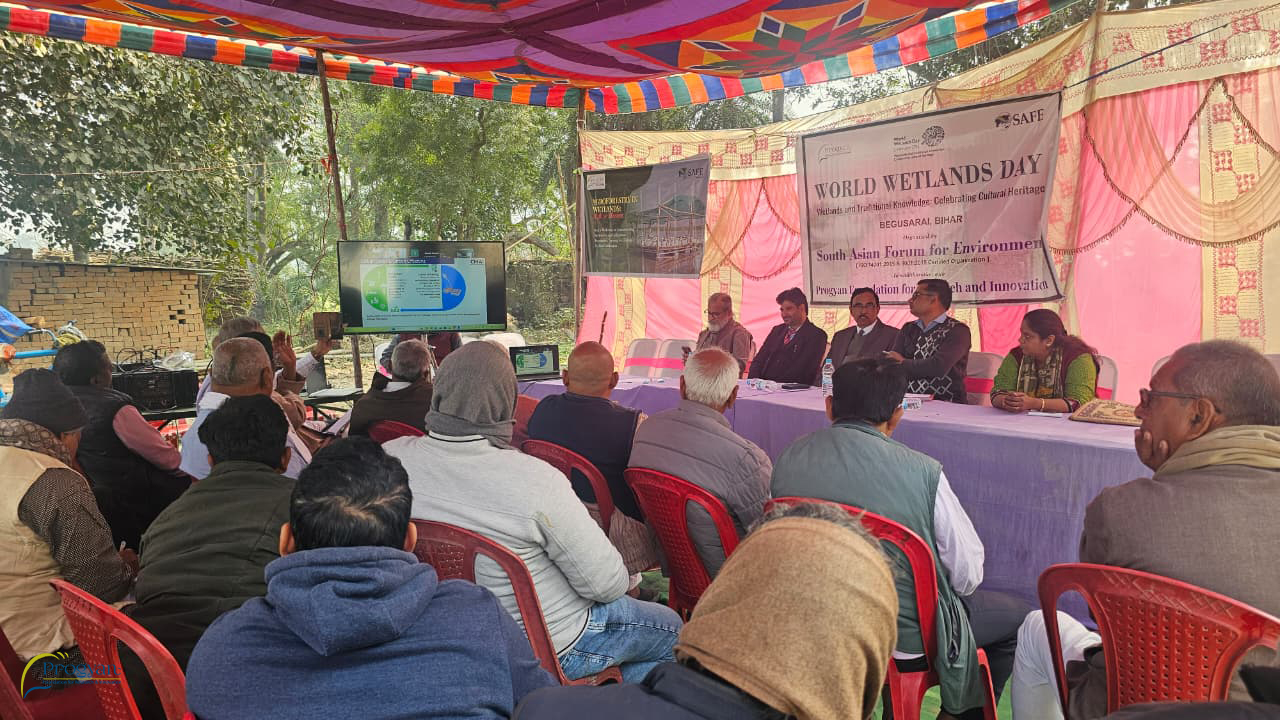
On 2nd February 2026, marking World Wetlands Day, the Progyan Foundation for Research and Innovation (PFRI) and the South Asian Forum for Environment (SAFE) successfully organised a one-day review workshop titled ‘Agroforestry in Wetlands: Myth or Mission?’ at Kanwar Taal, Begusarai (Bihar) in collaboration with knowledge partner – the Centre for Atmospheric Sciences (CACS), IIT Madras.
Held in one of the most ecologically significant wetland landscapes of India, the workshop focused on integrating agroforestry and indigenous regenerative farming practices to build climate-resilient, carbon-positive agricultural systems in flood-prone regions. The event brought together agricultural scientists, policymakers, financial institutions, climate experts, and farmer representatives from 18 Community Development (C.D.) Blocks of Begusarai, with two farmers from each C.D. Block.
The plains of Begusarai face escalating challenges from recurrent flooding, soil degradation, and climate variability. Drawing on the experience of two years of field-based interventions, the workshop reviewed on-ground evidence showing how context-specific agroforestry models, nature-based solutions, and traditional knowledge could transform wetlands from perceived constraints into viable climate-smart solutions.
Dr. M. S. Malik, Dean, Faculty of Forestry, Birsa Agricultural University, Ranchi, and Dr. R. K. Meena, Dr. Rajendra Prasad Central Agricultural University, Samastipur, Bihar, underscored the immense potential of agroforestry in Bihar. They emphasized the critical importance of species selection tailored to wetland ecosystems to ensure ecological balance and long-term sustainability. The District Agriculture Officer assured convergence of government programs and urged SAFE to lead farmer capacity-building initiatives in new technologies. Rohit Kumar, Secretary General of the Carbon Market Association of India (CMAI), elaborated on the scope of carbon financing through carbon credits and green credits under Government of India schemes, highlighting opportunities for farmers to benefit from emerging carbon markets.
The programme also featured keynote insights from ICAR, NABARD, Krishi Vigyan Kendra Begusarai, and the District Agriculture Department, spotlighting pathways for carbon farming and voluntary carbon markets. A key highlight was the interactive dialogue with farmers, which enabled the documentation and validation of indigenous practices. Farmers voiced concerns about fading agrobiodiversity and faulty drainage systems that are weakening the wetland ecosystem of the Kanwar Taal Ramsar site.
The workshop demonstrated how traditional knowledge and cultural heritage can support science-led, community-driven, climate-smart agriculture in wetland landscapes, aligning with the theme of World Wetlands Day 2026 – ‘Wetlands and traditional knowledge: Celebrating cultural heritage’.